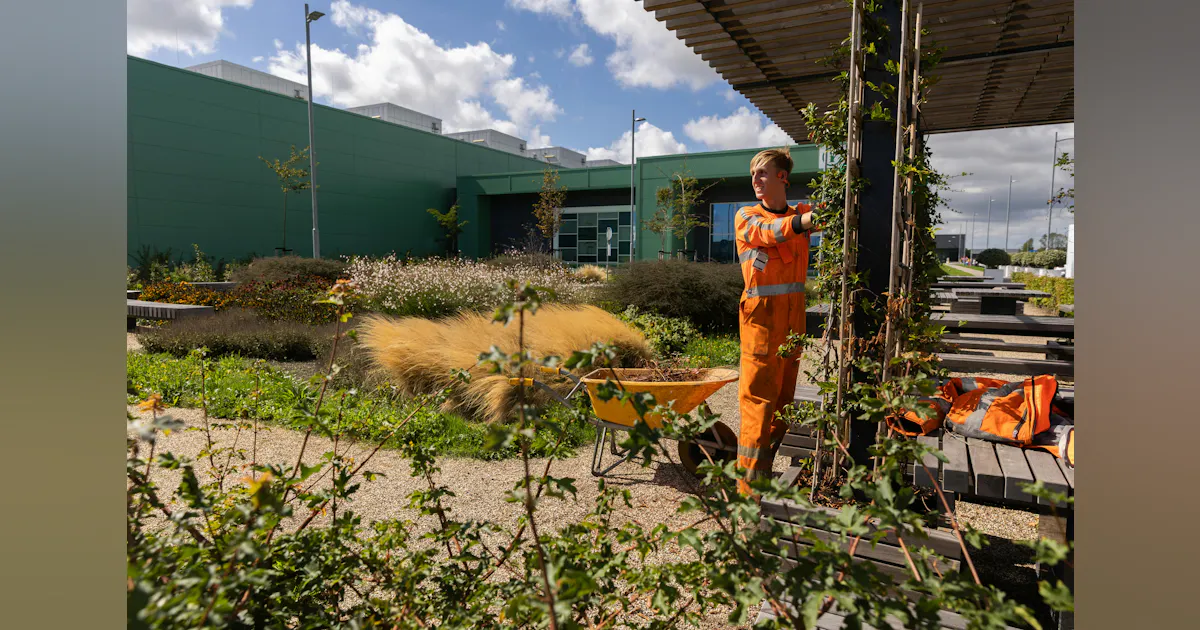
Microsoft is expanding a biomimicry-based approach to data center development, first tested at its Middenmeer facility in the Netherlands, to more than 20 locations across the United States and Germany, according to Data Center Frontier. The company says the practice will now be incorporated into all new U.S. data center projects.
Rather than a fixed template, Microsoft is building what it describes as a menu of biodiversity strategies that project teams can customize to local hydrology, vegetation, wildlife and community priorities. "We don't have a one-size-fits-all solution set; we actually have a menu of options that are going to be customized to each place," said Kaitlin Chuzi, Microsoft's director of Global Land Strategy.
The approach began in 2022 at Microsoft's Middenmeer data center in Noord-Holland, where the company planted 150 native trees and roughly 2,300 square meters of shrubs, grasses and groundcover after studying local habitats, soil health, and water quality. Six additional data centers planned in that region are now being designed around biomimicry principles. In the US, Microsoft's Chase City Conservancy in Mecklenburg County, Virginia — announced in 2022 and completed in April 2025 — protects more than 230 acres, including over eight acres of wetlands, more than 16,300 linear feet of restored streams, 185 acres of native pollinator habitat, more than 25,000 planted trees and over three miles of public walking trails. At its Mount Pleasant, Wisconsin AI data center development, Microsoft is working with the Root-Pike Watershed Initiative Network on wetland, prairie and riparian-buffer restoration, while a February 2026 groundbreaking in East Point, Georgia, incorporated community feedback into a vegetation buffer designed to screen the campus from nearby homes.
To evaluate whether these projects are working, Microsoft is using an Azure-hosted platform called Ecosystem Intelligence to quantify ecological functions such as biodiversity, water quality and noise reduction. The company's 2024 corporate sustainability report said it had permanently protected 15,849 acres, exceeding its goal of protecting more land than it uses by more than 30%.